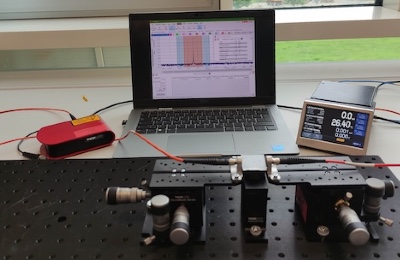
Detect food allergens in real time with RESAS
The RESAS project’s goal at TU Clausthal is to fabricate a portable device able to sense extremely low concentrations of food allergens within minutes.

The RESAS project’s goal at TU Clausthal is to fabricate a portable device able to sense extremely low concentrations of food allergens within minutes.

On 1 February 2024, a new ERC Starting Grant was started at Leibniz University Hannover (LUH). Prof. Dr. Philippe van Basshuysen has received the prestigious European Union funding to spend the coming five years researching how scientific models not only reflect the world but can also change it. His project MAPS – Managing Performative Science also develops strategies for dealing with this phenomenon in a better way.
After several decades of evolving, Open Access (OA) publishing is now at the centre of scientific communication, providing access to scientific publications without barriers. In Diamond Open Access, authors can publish free of charge as the institutional sector with universities, research institutions or libraries provide the necessary technological infrastructure.

Too hot, too dry, too wet: Europe’s landscapes have already been visibly affected by climate change. In recent years, floods and droughts have caused damage amounting to billions of Euros. The SpongeScapes project was launched in October 2023 and aims to counteract the consequences of climate change by establishing sponge landscapes. The European Commission is funding the research project with a total of 2.6 million euros under the Horizon Europe programme.
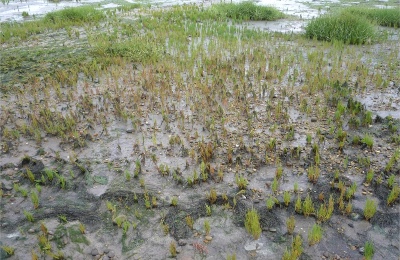
EU project Aquacombine focuses on the potential of halophytes with the participation of Leibniz University Hannover. Gourmets relish the tips of the plants, which taste like the ocean. But until now glasswort – also known as sea asparagus – has eked out more of a niche existence. To date the plant, which grows in salt marshes and mudflats, has not been used for large-scale industrial food production. This is despite the fact that plants like glasswort (Salicornia europaea) have many useful qualities.

Leibniz University Hannover (LUH) initiated the alliance EULiST – European Universities Linking Society and Technology. Together with nine partners, LUH has acquired funding within the framework of the European Commission’s European University initiative amounting to a total of 14.3 million euros provided over a period of four years. 1.6 million euros are allocated to LUH.